Why Women Don’t Keep Their Bags in the Overhead Compartment
On noticing the nature of hypervigilance.
Bombay, India.
Lately, I’ve been taking the AC train to CST railway station every day. The whole train is always packed, no matter where you're boarding in the morning. Since all the bogies are passage-way connected, sometimes I board from the men’s coach and sometimes, from the ladies’ coach. The AC trains are smaller in terms of seating capacity. So you can't have a 4th seat (a half seat) the way you would in a regular local.
What this also means is that there's less space overhead to keep your bags.
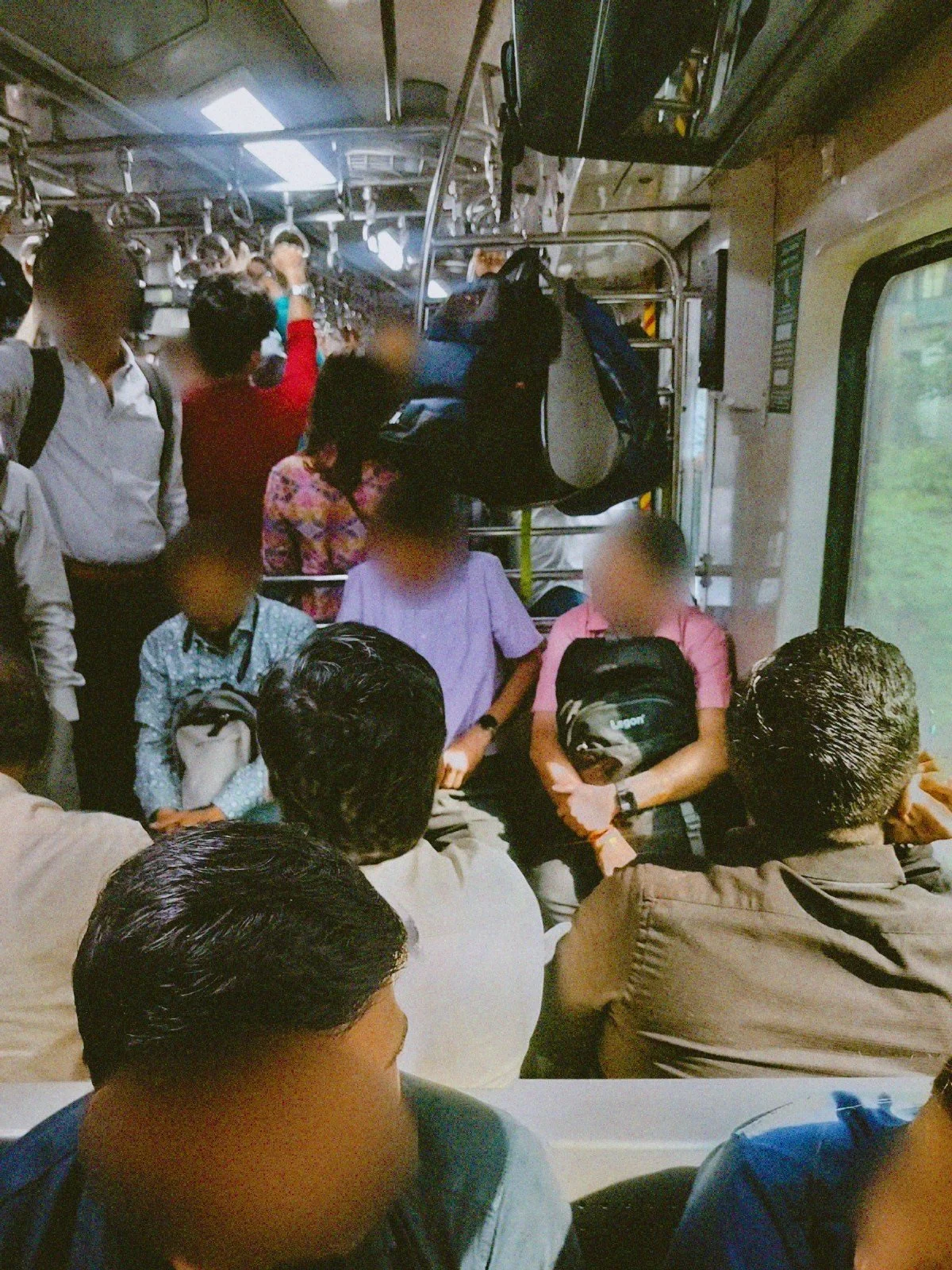
The men's compartment's overhead, I’ve noticed, has been fully optimised by its passengers to store their bags. A couple of gentlemen on the 9:10 am train even bring extra strong S-hooks to hang extra bags for their fellow passengers. Their bags are organised like books on a library shelf. Neck to neck, vertically, their spines visible neatly.
But the overheads in the ladies’ compartment often sit only half-full in a hellishly packed coach. Most women carry their bags on their front, even laptop bags, since it is more convenient for boarding and alighting. The practicality behind this is one of the oldest and largest unspoken understandings in Bombay commuter culture.
Women, once boarded, seldom let go of their bags. I’ve seen them keep their bags down on the train floor instead of depositing them in the overheads even if they're standing all the way to the very last stop.
This has not gone unnoticed by men in the adjacent coach, who, because of the connected bogies, have seen the shelves half-full. I’ve heard their banter. “Women and their obsession with their bags, I tell you,” one S-hook uncle guffawed with his other bag-free brethren as though this were just one long afternoon tea, and not an intimacy lesson on how armpits smell in an AC box.
I think fundamentally this stark visible contrast speaks to me of the most familiar relationship women have with hypervigilance. We've had things taken away from us so often, we maybe subconsciously just assume we're going to lose our water bottles, our dabbas or a magazine the same way we’ve often lost agency over our minds and bodies, without notice, and to the silent violences of being forced to negotiate with “No”.
For many women like me (I include trans and nonbinary folks in my definition), bags have been the first line of defence against being groped. A friend I was speaking to about this piece told me how they always boarded with their bags to the front to restrict or block access to their breasts. As someone with large breasts, I’ve often used multiple bags to block access to being perceived as someone who has them. Sometimes I carry a jacket in the smouldering heat for the same reason.
I still carry the relief of masks being normalised post-COVID. It was strange to feel safe in public during a pandemic because social distancing restricted access to the physical space around my body and masks protected me from being perceived.
There are, of course, practical reasons for not using the overheads. Some of us do need more things, more sips of water, a wipe. Many put on makeup on the way, because beauty standards mean there are more things to carry here too; many work on the way; many write journals on the way.
And I want to linger on the “more things” for a second. I once heard a gym bro in a video tell his partner not to worry about her tummy fat because her body had more organs to protect. His consideration lingered with me in the warmer places of my heart.
Since government policy and the uncles who love telling me my gender love biological reductionism, where is the consideration that the bodies they are so invested in categorising might also have material needs?
Many menstruators sweat more on their period, so they need quicker access to a wet wipe. Pain is a constant, so a bulky, portable hot water bag? Yes. I have more neck and shoulder strain from breast tenderness, so I often carry a neck pillow for the long ride. These things do not exist in some abstract category of “women’s things”. They are objects required to negotiate a body in the world.
Depositing this world of needs on the overhead cuts off ease of access to it. So we hold our worlds close to our chest.
In this liminal space in the ladies’ compartment—between working for no money at home and working for some money in an office—many women live for themselves. We see entire communities form in these trains. Sony once made a TV show called Ladies Special about the Ladies Special local trains, like the one that runs between Kalyan and CST, where women formed intense friendships that are deeply untangled from their familial lives.
It is telling that even in the thrall of this community, women find it difficult to let go of what is more familiar than any found family: our respective hypervigilances.
Sometimes I am hopeful that hypervigilance has a moment to retire when I see women hand their bags over to other women to just hold, not even place them in the overhead compartment, but just hold them like they are trusting each other with themselves. In that space I glimpse the rare trust that what belongs to them might just stay theirs in the hands of another.
In light of women taking to the streets in India yet again to ask for the right to take up space in the country, with the revolution sitting in our hands amid so many questions of "Why didn't she report this?" I look at the bags placed in the overheads of the train in the men's compartment and at the bags held on for life in the women's compartment as a visual example of the corrosive, intimate, and ultimately most familiar relationship women share with hypervigilance.
Sometimes, even in the hands of their trusted train-friends, some women’s eyes still return to their bags ever so often, through sheer reflex from decades of wearing armour.
The hypervigilance never alights from the train.